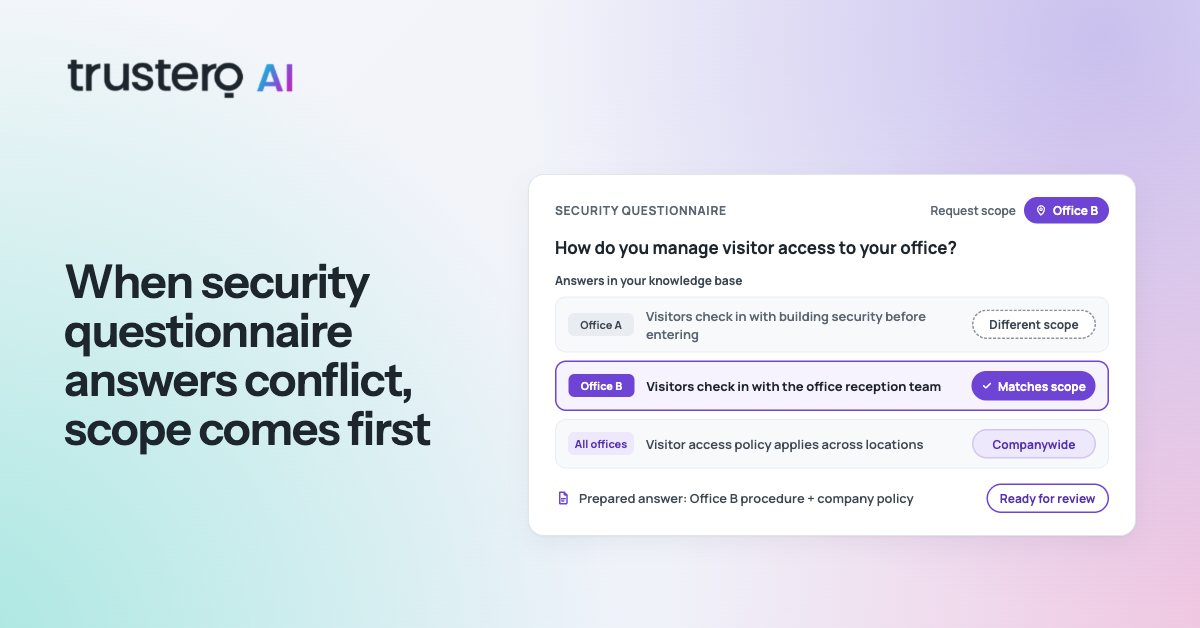

A security questionnaire asks how your organization manages physical access to its offices. Your knowledge base contains several previous answers. Each describes a different process, and each looks reasonable. Which one belongs in the response?
For an organization operating across multiple locations, the answer may depend on which office the questionnaire covers. What appears contradictory can be accurate for different environments. Choosing one response and applying it everywhere can turn a correct statement into a misleading one. Buyers use these answers to judge third-party risk, and that risk is growing: Verizon’s 2025 Data Breach Investigations Report found that third-party involvement in breaches doubled in one year, from 15% to 30%.
Questionnaire automation needs to move beyond matching questions to previous answers. It needs to connect the question, the relevant scope, and the information that supports the response. Trustero’s questionnaire workflow brings that context into the work, helping teams reuse their knowledge without treating every answer as universally applicable.
Different locations can have different correct answers
A well-maintained knowledge base does not necessarily contain one answer to every question. It may contain several valid answers, each with a different boundary: an office, a business unit, a service, or a period of time. The key distinction is whether the information actually conflicts or describes different circumstances.
Consider an illustrative example involving visitor management. One office requires visitors to check in with building security before entering the company’s space. Another manages check-in through its own reception team. Both descriptions could accurately answer the same question about visitor access, but neither should automatically become the organization’s companywide answer.
A true contradiction is different. If two records describe the same office during the same period and disagree about its visitor procedures, someone needs to establish which information is authoritative. Selecting the most frequently repeated answer would not resolve that uncertainty.
The practical question therefore goes beyond “Have we answered this before?” to “Have we answered this for the environment this requester is asking about?”
A response library does not remove the scoping work
One customer scenario illustrates the challenge. The organization receives a high volume of security questionnaires and operates offices across several states. Its historical responses vary by location, so a previously completed questionnaire can be a helpful starting point without being the correct answer for every new request.
A shared library makes those responses easier to find. But finding information and determining whether it applies are separate tasks.
Without scope-aware assistance, a responder may still need to locate the relevant questionnaire, confirm the office it describes, compare similar answers, and adjust the wording for the incoming request. A familiar question can trigger another round of research because the team needs to reconstruct the context behind the previous response.
That work is heaviest when a questionnaire mixes companywide questions with location-specific ones. A corporate policy answer might apply broadly, while a description of office procedures needs a narrower scope. Treating every question as universal, or every question as location-specific, can miss that distinction. Standard questionnaires already account for scope. The Shared Assessments SIG, for example, comes in lighter and more detailed versions so requesters can match the questions to the relationship.
How Trustero connects the questionnaire to its scope
In the customer workflow described, the team uploads previously answered questionnaires for its different locations into the knowledge base within Trustero’s Questionnaire module. Those documents give the workflow a body of existing responses and the context associated with them.
When a new questionnaire is uploaded, Trustero’s AI agents analyze it to determine the relevant scope and use the applicable information to prepare answers. Rather than retrieving a passage that resembles the question, it uses context to connect the request to the applicable response.
This gives location-specific answers a legitimate role in a shared knowledge base. Teams don't have to flatten meaningful differences into a single generic statement just to make their information reusable.
Teams still need clear source context. Previously completed questionnaires should identify their location and other relevant boundaries. Reviewers should also confirm that the incoming request provides enough information to support the proposed scope.
When a request does not identify the relevant office, the appropriate next step may be clarification. When it covers multiple offices, the response may need to explain the differences. Those are review decisions, and neither justifies silently extending one location’s answer across the organization.
A growing knowledge base becomes more valuable through context
Previously answered questionnaires are only one source of information. The Trustero workflow described can also draw on relevant information available within the organization’s Trustero account to help prepare responses. This broadens the material available beyond the wording captured in earlier questionnaires.
This helps when the organization already has the information needed to answer a question but hasn't used it in that questionnaire format. The opportunity is to reuse existing organizational knowledge rather than require someone to reconstruct the response from scratch.
As teams add reviewed questionnaires and other relevant information, the workflow has a richer source base to draw from. Another location’s questionnaire can expand coverage. An updated response can provide a more current description. Clearer source material can make an answer's boundaries easier to understand.
This is the practical value of a knowledge base becoming better informed: it provides more relevant context for future work. Document volume alone does not guarantee better answers.
Teams still need to maintain the material they rely on. An old questionnaire should not become a permanent statement of current practice, and a newer document should not automatically override a location-specific answer unless it applies to that location. Consider currency and scope together.
Save expert time without giving up expert judgment
The operational benefit is a shift in where people spend their time. Instead of repeatedly searching old questionnaires and rebuilding answers, reviewers can focus on whether a prepared response fits the request and is supported by current information.
That review should be substantive. Does the answer describe the correct office? Does it distinguish companywide policy from local implementation? Does the wording claim more than the source supports? Where information actually conflicts, the responsible owner still needs to resolve the underlying issue.
This division of work fits Trustero’s approach to AI-supported GRC: use organizational context and specialized agents to reduce repetitive work, while qualified professionals retain responsibility for material decisions. The AI helps prepare the response; the team remains accountable for what it communicates externally.
For security and GRC leaders, the outcome to evaluate goes beyond the number of completed fields to the reduction in searching, rewriting, and avoidable follow-up needed to reach a reviewed response. A draft that preserves the correct context can be more valuable than a seemingly complete questionnaire that requires extensive correction.
A strong knowledge base does not force every office to tell the same story. It helps your team give an accurate answer for the part of the organization being asked about.