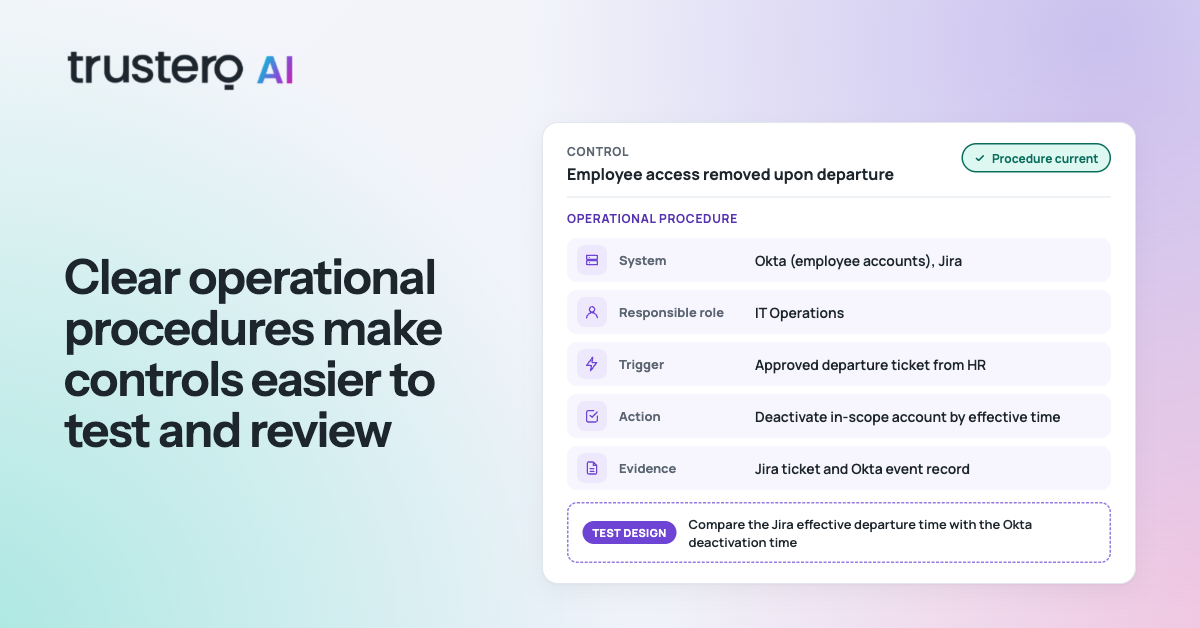

A control owner may know exactly how a control works. But when the written description leaves out the system, responsible team, or actual steps, everyone else has to fill in the gaps. Test preparation and audit review can become exercises in reconstructing information that should already be documented.
A customer conversation reminded us of the importance of keeping the Operational Procedure field precise and current. The field needs to describe how a control is implemented, including the actual tools, the responsible roles, the cadence or trigger, the actions performed, and the evidence produced.
An accurate operational procedure gives control testing and audit review a shared starting point. It helps teams spend less time explaining the workflow and more time evaluating whether the control is doing what it should.
A control objective does not explain the implementation
A control objective describes the intended outcome. An operational procedure explains how the organization puts that intent into practice. A statement such as “Employee access is removed upon departure” leaves important implementation questions unanswered: which accounts are covered, how the departure is communicated, who removes access, and what records demonstrate completion. In a 2026 Sagiss survey of 1,000 U.S. workers who had left a job, 79% said at least one work account or access point kept working after their last day.
Those details become important when someone other than the control owner needs to understand the process. A new team member should not have to schedule a meeting simply to identify the relevant system. A test designer should not have to guess whether the evidence comes from an identity platform, a ticketing system, or both.
Specificity also keeps the description from implying more coverage than the process provides. A procedure scoped to one identity platform should not imply that it covers every independently managed application. Naming the tool helps; explaining the relevant scope makes that name meaningful.
The goal is to describe the process that actually operates, without repeating a framework requirement or documenting a future-state process as though it already exists.
Write the procedure someone else can follow
A complete operational procedure connects five elements: the system or formal process, the responsible team or role, the cadence or trigger, the actions performed, and the resulting evidence. Together, those elements should let a reader follow the path from the event that starts the work to the record that shows what happened.
Use the actual system names and identify the relevant environment or population where necessary. Name the responsible role rather than relying on an individual’s name alone, and replace vague phrases such as “reviews as needed” with the actual frequency or triggering event. Describe observable actions rather than broad assurances such as “ensures appropriate access.”
For an illustrative control limited to employee accounts in Okta, the procedure could read: “When HR submits an approved employee-departure ticket in Jira, IT Operations deactivates the employee’s in-scope Okta account by the effective departure time specified in the ticket. The team verifies the deactivated status, records completion in Jira, and retains the ticket and corresponding Okta event record as evidence.”
That description gives the reader something concrete to work with. It identifies the tools, responsible team, trigger, actions, timing expectation, and evidence without requiring a separate explanation of the basic workflow.
The field does not need to become a click-by-click runbook. Keep enough detail to explain the implementation, and reference supporting instructions where necessary without including credentials or unnecessary security-sensitive information.
Use the procedure to design a test that reflects the process
The operational procedure provides implementation context for drafting test procedures. It helps the test designer identify where to look, what action to evaluate, when that action should occur, and which records could support a conclusion.
In the illustrative departure process, a test could compare the approved effective departure time in Jira with the account-deactivation time recorded in Okta. It could also inspect whether completion was documented. These are more specific steps than asking someone to “verify that off boarding is performed.”
The tester still needs to establish the relevant population and period. A set of completed tickets does not, by itself, establish that every relevant departure is represented. The operational procedure guides test design, but it does not replace the work needed to determine whether the evidence is complete and appropriate.
Test design must also consider the control’s objective and requirements. If the documented process leaves out required systems or actions, designing a test around that omission does not resolve the gap. The mismatch needs attention rather than a narrower test that makes the process appear sufficient.
A clear procedure describes expected operation; it does not prove that operation occurred. That conclusion still depends on evidence and review.
Update the procedure when the operation changes
An operational procedure can become misleading even when the control continues to operate. The team may move to a different ticketing system, transfer responsibility, change a review frequency, or start producing a different evidence artifact. If the field remains unchanged, readers are directed toward the previous process. Uptime Institute’s 2025 Annual Outage Analysis found that 85% of outages caused by human error stemmed from staff failing to follow procedures or from flaws in the processes and procedures themselves.
Treat those operational changes as documentation triggers. Assign responsibility for confirming that the description still matches the work, and include the field in control-owner handoffs and planned control reviews. Updating it should be part of completing a process change instead of waiting until an auditor asks a question.
A practical maintenance check is to compare the procedure with a recent completed instance. Do the system names match? Did the named role perform the described actions? Does the expected report, ticket, or other evidence actually exist?
When a process changes during an audit period, preserve the effective date and the prior procedure in the supporting documentation. The current field should explain today’s implementation, while the historical record should help reviewers understand evidence produced under the earlier process. Updating the description should not erase that distinction.
Give reviewers a clear starting point in Trustero
Within Trustero, keeping the Operational Procedure field current for each control makes implementation context available alongside the control being reviewed. A teammate, or an auditor given appropriate account access, can read how the control operates before asking its owner to explain the basics again.
That can make follow-up more focused. Instead of starting with “Which system do you use?” or “Who performs this step?”, the reviewer can ask whether the supplied records support the documented actions. The discussion focuses on evaluating the workflow’s operation instead of reconstructing it.
Clear documentation does not eliminate the need for auditor questions, walkthroughs, or additional evidence. It gives those activities a more informed starting point. Control owners remain responsible for confirming that the description is accurate, and reviewers still need to evaluate the evidence rather than treating the field as proof.
The practical benefit extends beyond audit preparation. A current procedure supports handoffs, gives test designers a consistent reference, and can reduce repeated explanations across the team. Its value comes from being specific enough to use and current enough to trust.
A control should not depend on its owner being in the room to be understood. Keep the operational procedure current so testing and review begin with the process that actually exists.