
Creating a control test procedure can look like a writing assignment. In practice, the difficult work starts before anyone drafts the test: determining exactly how the control operates, what evidence it produces, and what would demonstrate that it worked. When those details are unclear, test development becomes a process of discovery.
In our work with customers onboarding to Trustero, we have seen controls recorded in spreadsheets or platforms such as Archer, while important operating details remain in conversations and anecdotes. Wherever the control is stored, accurate testing depends on whether the documented information provides enough context.
For some of these customers, repeatable testing creates a business use case for developing and maintaining detailed procedures that weren't previously clear. Operational documentation becomes something the testing process depends on, rather than a separate project. That changes both the priority of the work and the reason to do it.
The writing is only part of the work
A control statement can describe an expectation without explaining how the organization fulfills it. It might identify an activity and a frequency while leaving the responsible role, system scope, exception handling, or completion criteria unstated. A test designer still has to resolve those questions.
Without an accurate operational procedure, that work can involve interviews with control owners, comparisons with existing guidance, and reviews of available evidence. The designer must distinguish what the documentation says, what people describe, and what the records demonstrate. Those three sources may not agree.
That is why a template alone cannot make test development straightforward. Reusable language helps organize the procedure, but it cannot settle an unresolved question about how the control should operate. The harder task is making those decisions explicit and having the people responsible for the control validate them.
Give operation and testing distinct jobs
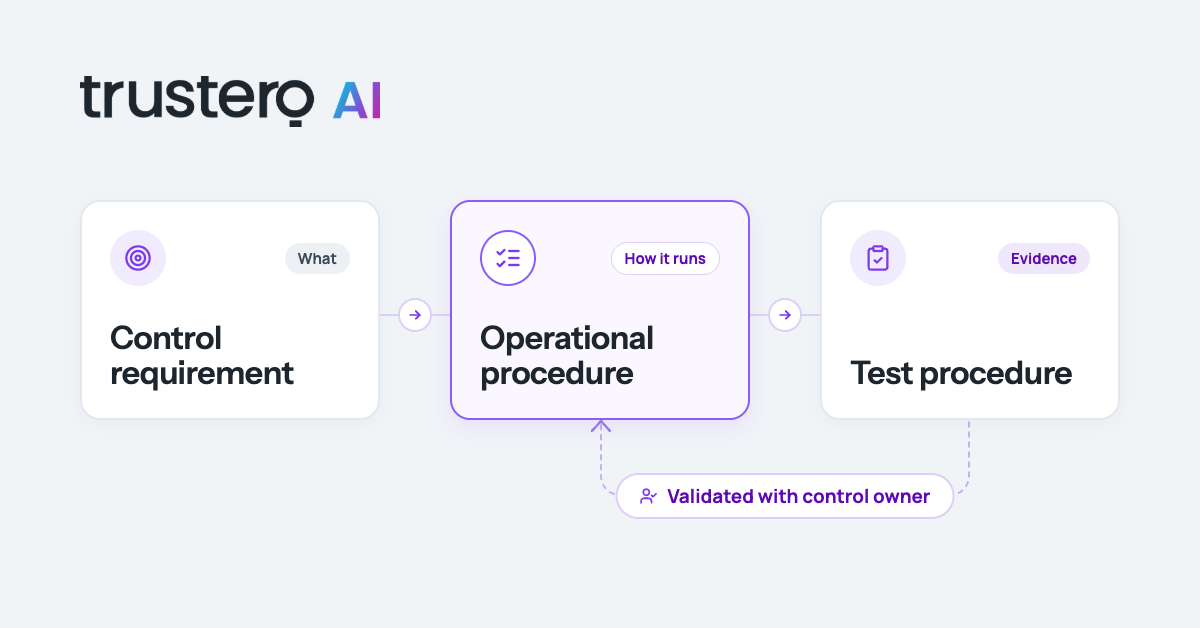
Start by separating the control requirement, the operational procedure, and the test procedure. The requirement establishes what must be achieved. The operational procedure explains how the organization carries it out; the test procedure explains how to evaluate whether it did so.
Consider an illustrative access-review control that requires a quarterly review of privileged accounts. The operational procedure needs to identify the relevant systems and accounts, who conducts the review, how it records decisions, and how it handles inappropriate access. Implementation guidance should make those expectations usable for the person performing the work.
The test procedure has a different job. It should define the review period, the evidence to inspect, how the scope of the review will be checked, and the criteria for evaluating the result. A record showing that a review occurred does not, by itself, establish that it covered the required accounts or that it addressed identified issues.
These documents should connect, but they should not be interchangeable. Asking someone to “verify that access was reviewed” leaves too much unstated unless the operating expectations and evidence requirements are already clear.
One customer recognized the dependency
One Trustero customer identified exactly this problem: its operational procedures did not accurately reflect how it complied with its controls. As the team considered how to develop accurate tests, it recognized that the operational documentation needed attention first.
Writing more detailed tests from an inaccurate procedure would repeat the mismatch in the tests. The customer therefore identified a prerequisite for better test design: update the operational procedures so they accurately describe how the controls are fulfilled. Improving the test language alone would not resolve the underlying issue.
That realization gave leadership a concrete business use case for the updates. The work now had a defined purpose: establish an accurate operational foundation for creating procedures that could correctly test compliance with the controls.
The order of operations matters. Accurate testing depends on a validated understanding of how a control operates, and developing the test can show leadership why that understanding deserves investment.
Validate the process before translating it into a test
Begin with a control owner and walk through one control as it operates. Confirm the activity, ownership, scope, frequency, evidence, and response to exceptions. Use that discussion to reconcile the written procedure with the process and records, rather than treating either the document or an anecdote as the complete answer.
Documenting current practice does not make that practice compliant. The team still needs to assess whether the process satisfies the control requirement. If it does not, address the gap rather than weakening the test until existing evidence produces a pass.
Once that foundation is validated, implementation guidance can explain what the control owner needs to do, and the test can specify what the reviewer needs to evaluate. Make the expected evidence and decision criteria explicit. Missing evidence, unclear instructions, and an observed failure should not be reported as the same unexplained result.
Start with a small set of controls rather than treating the entire library as one documentation project. Use the first procedures to establish a repeatable approach, then revisit related tests when the underlying process changes. Keeping procedures accurate needs an owner beyond the initial rollout.
Give leadership an assurance outcome to invest in
The business case is stronger when it describes what clearer procedures make possible. Control owners need usable guidance, testers need explicit criteria, and reviewers need to understand why the evidence supports the conclusion. The same investment in operational clarity supports all three.
It also gives leaders a better measure of progress than a count of completed documents. Can a reviewer follow the connection from the control requirement to the operating activity and supporting evidence? When testing finds a mismatch, can the team determine whether the problem is the procedure, the execution, the evidence, or the test design?
This connects directly to Trustero’s emphasis on organizational context, evidence-supported analysis, and human-reviewed control assurance. AI can support repetitive analysis, but it should not fill in missing operating details with assumptions. Qualified people still need to validate the procedure, review the evidence, and retain authority over material conclusions.
Accurate operational procedures make tests easier to write, and they give the business a clearer basis for trusting what those tests report.