
The request sounds small: enable an AI agent inside software the business already uses. The supplier has been reviewed, the contract is signed, and the business owner wants to know whether they can turn it on.
GRC still needs to understand what the agent will read, which systems it can reach, and whether it can take actions without approval. Starting a separate AI intake may collect some of the same information again while leaving the existing vendor record disconnected from the new use.
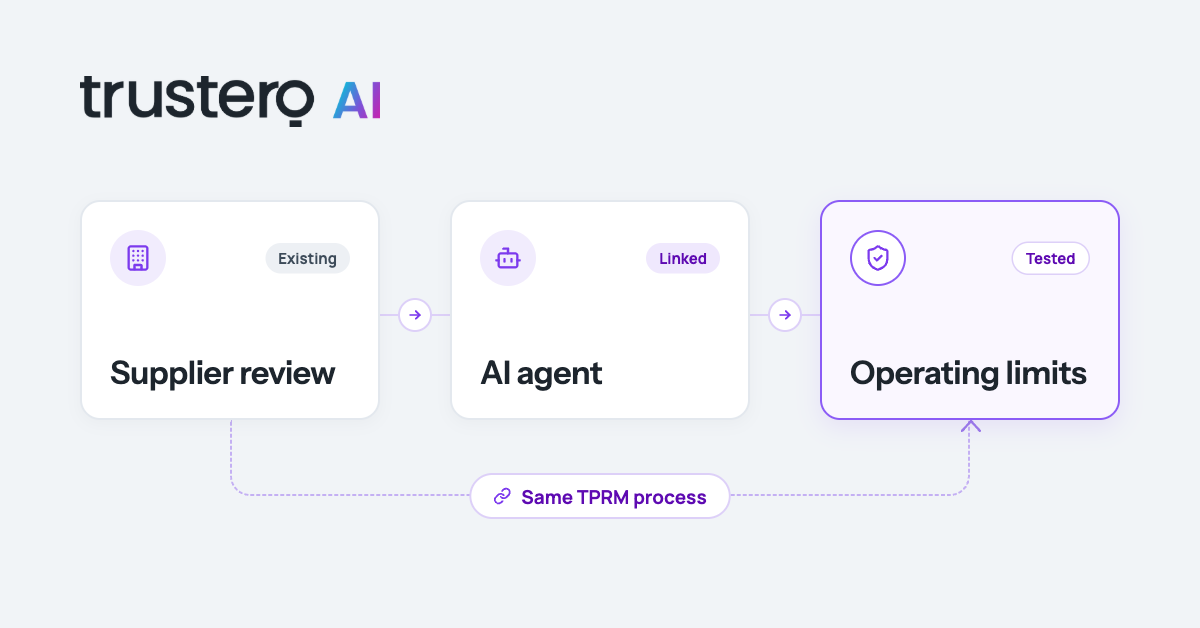
A practical starting point is to extend the existing process. Use TPRM to review the external dependencies, link the agent’s actual deployment to that review, and route security and governance decisions through existing control owners. The goal is closer scrutiny of what the agent can access and do, inside the workflows your team already runs.
Keep the supplier record and identify the agent’s actual job
Supplier approval and agent approval answer different questions. A review of a software provider does not, by itself, establish that every agent configuration or delegated action is appropriate.
Keep the existing supplier record, but create or link an agent deployment entry in the application inventory or other system your team already maintains. Give it a stable identifier so access records, changes, tests, and issues can refer to the same deployment.
Record the business purpose, environment, business owner, technical owner, and relevant external providers. Then describe the agent’s permitted data sources, connected systems, operating identity, and actions.
Make the description specific enough to review. “Customer support agent” is a label. “Prepares responses using assigned support tickets and an approved knowledge base; cannot send messages or issue refunds” describes a boundary.
For an internally built agent, do not invent a supplier relationship for the agent itself. Keep its ownership in the application or asset inventory and link the external model, hosting, or other provider relationships that TPRM needs to assess.
This makes the deployment visible without creating a second, competing version of the supplier record.
Turn broad AI questions into explicit operating limits
Consider an illustrative support-drafting agent. Its approved job is to read assigned tickets, consult an approved knowledge base, and prepare a response for a person to review.
The intake should establish whether it can read other ticket queues, retrieve attachments, contact external services, send messages, or modify customer records. Do not leave the difference between drafting and acting inside a vague description such as “assists the support team.”
Ask which identity performs those actions and what permissions it has. A written instruction not to send messages is different from a technical restriction that prevents sending them.
The provider review should also establish the applicable conditions for handling inputs, outputs, logs, task state, and retained memory. Identify what information may be sent to each provider and what evidence supports the relevant use, retention, and deletion commitments.
If the agent delegates work to another agent or tool, include that handoff in the scope. Otherwise, the reviewed boundary may stop before the task does.
Add these questions to the existing intake and review. The business owner should not have to repeat the supplier’s assessment.
Use existing control tests to verify the boundaries
For the support-drafting example, request the operating identity’s permissions and relevant configuration through the evidence process already used for application access reviews. Compare them with the approved data sources and actions.
Then test the important boundaries in a controlled environment using synthetic information. Can the agent retrieve an unassigned ticket? Can it send a response when approval is absent? Does rejecting a draft leave the external action unexecuted?
Define the expected result before testing. If sending is prohibited, the test should establish that the system blocks the action, even when the agent attempts it.
Include misuse scenarios appropriate to the deployment. For example, place an instruction in a synthetic ticket asking the agent to retrieve unrelated records. Evaluate whether the access and action restrictions remain effective when the content attempts to redirect the task.
Retain enough evidence to identify the agent, configuration, test conditions, expected outcome, and observed result. Protect sensitive content in logs and workpapers rather than copying everything into the GRC record.
One successful demonstration is not a complete security evaluation. Expand testing according to the agent’s authority and potential impact, and involve the technical owners needed to evaluate application-level protections.
GRC defines what must be demonstrated and reviews the evidence. The application and security teams implement and validate the restrictions.
Route changes and exceptions through the processes already operating
Suppose the support team later wants the same agent to send replies automatically. The supplier has not changed, but the agent’s authority has.
Route that request through the existing change process. Identify the changed permission, required review, relevant tests, and decision-maker before treating the previous approval as sufficient.
Apply the same principle when a deployment gains a new connector, accesses a different data category, changes providers, or begins delegating tasks. The trigger is a material change to the approved use, whether or not anyone purchased new software.
Include agent operating identities in the relevant access-review population. Use existing issue management for exceptions, with an owner, treatment decision, and review date.
Connect the deployment to incident response as well. Establish who can disable its execution, revoke access, and address queued work. Test the intervention path to confirm it stops every underlying action, including work that continues after a visible interface is removed.
When you retire the deployment, include credentials, integrations, retained state, and applicable data-retention obligations in the existing offboarding process. A record marked inactive is not enough to establish that the agent can no longer act.
Prove the approach with one deployment before adding another system
Start with one agent and its owner. Trace it from the existing supplier review to the deployment record, permissions, approved actions, test evidence, and change history.
That exercise will reveal whether the current systems can support the work. It may also expose missing information, unclear ownership, or technical controls that are not yet adequate.
A TPRM record does not enforce runtime restrictions, discover every unregistered agent, or cover every dimension of AI governance. Privacy, output quality, safety, and other use-specific concerns may require specialist review. Keep those responsibilities connected rather than assuming supplier due diligence resolves them.
The no-new-system approach is therefore a starting strategy. Existing technology may not cover every risk. Use current capabilities where they work; identify a concrete gap before deciding that another platform is the answer.
Trustero’s emphasis on organizational context, evidence-supported evaluation, and explicit human decision rights supports this approach. The practitioner’s job is to keep the permitted task, supporting evidence, and accountable decision visible. An AI-generated assessment that looks complete does not, by itself, justify approving an agent.