
In the first article in this series, we focused on reducing audit preparation by connecting requests to evidence already collected and tested. That approach brings another responsibility: deciding what happens when the monitoring identifies a real problem.
Finding a gap before the auditor does gives the team an earlier opportunity to act. But detection alone doesn't strengthen the control, reduce exposure, or prevent the issue from happening again.
A mature GRC or information security program should show the full response: what it found, how it evaluated the finding, who took responsibility, what changed, and how the team verified the improvement. That progression, more than the number of passing tests, is what makes continuous control monitoring valuable.
Make an accountable response the objective
An empty findings register can look reassuring, but it does not explain how thoroughly controls were tested. It could reflect effective operation, limited coverage, incomplete evidence, or tests that ask the wrong questions.
The reverse also needs care. A growing list of findings does not automatically indicate maturity. More detection helps only when the results are valid, prioritized, and acted on.
The objective should be a dependable response to real problems. Can the team distinguish a control failure from an evidence limitation? Can it explain the risk, assign responsibility, and verify what happened next?
An internal monitoring result is also not automatically a formal audit finding. Treat it first as a signal that needs evaluation against the control’s requirements and the supporting evidence.
This creates a healthier expectation for practitioners: identifying an issue is part of operating the program. An unexplained or repeatedly unresolved validated issue demands further attention.
Validate the gap and preserve the original condition
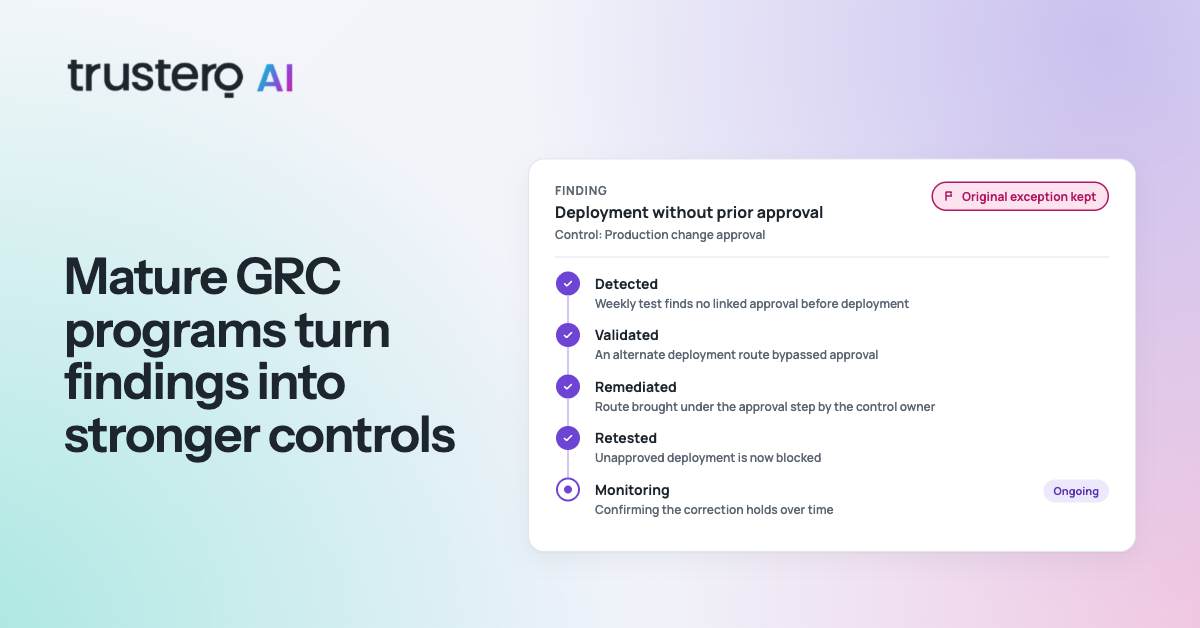
Consider an illustrative production-change control. A weekly test identifies a deployment with no linked approval recorded before deployment, even though the organization’s control requires one.
At that point, several explanations remain possible. The approval may be missing from the collected evidence, the test may have matched records incorrectly, or the required approval may never have occurred. An authorized emergency-change procedure could also affect the evaluation.
Check the source records, timestamps, applicable procedure, and test criteria before declaring a confirmed control failure. If the issue is incomplete evidence, record that limitation and obtain what is needed. If the test is wrong, correct it and identify which results need reevaluation.
Once the gap is confirmed, document the requirement, observed condition, supporting evidence, affected scope, and the period that can reasonably be established. Distinguish when the problem occurred from when the team detected it.
Preserve that original condition as remediation proceeds. A later passing result should not overwrite the history needed to explain the issue.
This record gives the next person enough context to act without reconstructing the investigation, and it gives reviewers a basis for understanding the eventual resolution.
Fix the issue and the reason it could happen
Continuing the illustrative example, suppose the investigation confirms that an alternate deployment route bypassed the required approval step.
Adding an approval to the ticket afterward does not establish that the pre-deployment control operated. The team needs to evaluate the deployed change, address any resulting risk, and decide how to prevent that route from bypassing the requirement again.
Separate immediate response from longer-term correction. Reviewing the deployed change may help address the immediate uncertainty. Restricting the bypass route or bringing it under the appropriate approval mechanism addresses how the failure occurred.
Assign an accountable remediation owner, an expected completion date based on risk, and a clear definition of the evidence needed to demonstrate completion. GRC can coordinate and challenge the response, but the technical or business control owner must implement the operational change.
Then examine whether the same cause could affect other deployments or systems using that route. A narrow correction is insufficient if the underlying weakness is shared.
Some issues may require temporary mitigation or an authorized risk decision while you make a permanent change. Document that decision separately. An accepted risk or approved exception is not the same thing as a repaired control, and it should not be described as one.
Retest the repair and check that it holds
A completed remediation ticket shows that someone reports having performed the work. Verification should establish whether the intended control now operates.
For the illustrative deployment issue, test the changed route under controlled conditions. Confirm that a deployment without the required approval is prevented and that an appropriately approved deployment can proceed. Where an emergency path is authorized, evaluate it against its own requirements.
Define those expected outcomes before testing. Otherwise, the team risks collecting convenient evidence without establishing that the original failure has been addressed.
Immediate retesting demonstrates the changed condition at that point in time. Subsequent monitoring helps evaluate whether the control continues to operate as expected. The appropriate observation period and coverage depend on the control and the risk; one passing run does not prove sustained effectiveness.
Keep the original failure scenario in the relevant test procedure so you can detect the same condition again. Confirm that evidence collection still covers the affected route and that missing data cannot produce an apparent pass without anyone noticing.
If the issue recurs, revisit the cause rather than simply reopening the same task. The repair may have been incomplete, another route may exist, or ownership may still be unclear.
Show the improvement without erasing the exception
Leadership and auditors need more than a status change from failed to passed. They need a supported account of what happened and what the organization did about it.
A complete record connects the original issue to the risk evaluation, accountable owner, corrective action, verification evidence, and subsequent monitoring. Where uncertainty remains, state it rather than treating closure as proof that every question has been resolved.
For program management, look at unresolved material gaps, time to contain exposure, overdue remediation, completed fixes awaiting verification, and recurring failures. Interpret those measures alongside monitoring coverage and evidence quality. Broader testing can reveal previously unseen issues; a lower count alone does not demonstrate improvement.
For the audit, keep a clear distinction between the historical condition and the current one. Remediation may improve the control going forward, but it does not change what occurred during the period under review.
Trustero’s recurring evidence collection and control testing support earlier detection of potential gaps. The value depends on what the team does with those results: review the evidence, make accountable decisions, implement corrections, and verify the outcome. AI-supported analysis assists that work; it does not assume responsibility for risk acceptance or remediation.
This is the practical connection between audit readiness and program maturity. The team can explain why a control passes and how it responds when it doesn't.
The finding is the starting point. The proof of maturity is what the team changes and whether that change holds.