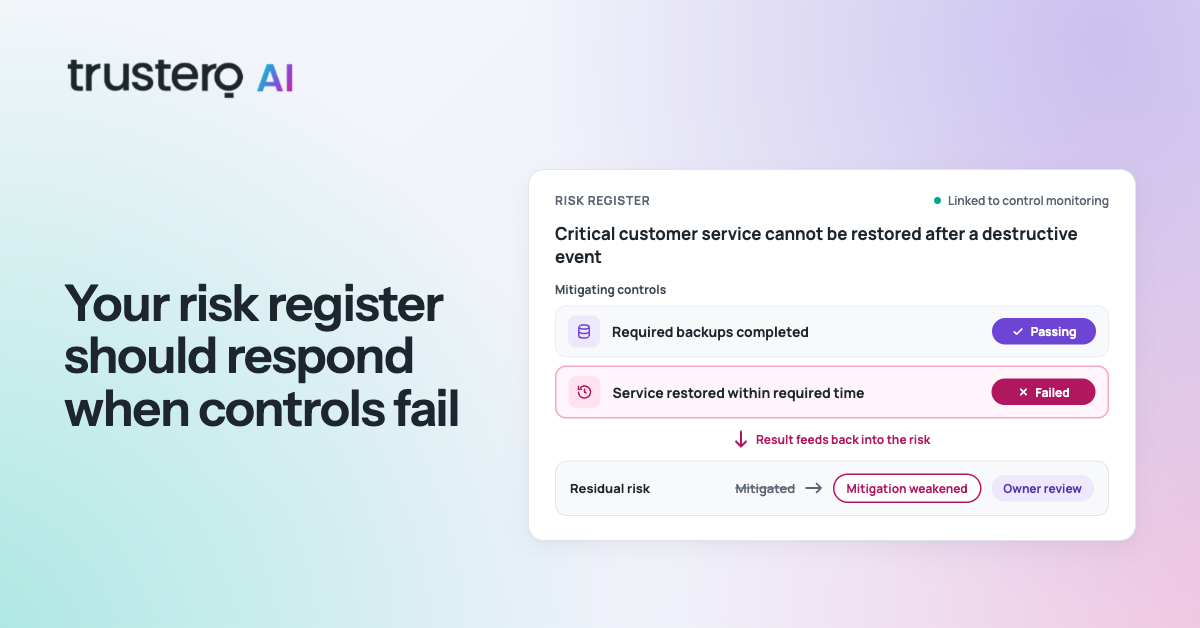

A risk entry can have an owner, a treatment plan, and a completed corrective action and still be disconnected from the control it depends on. When that control fails, the register may continue to show the same residual risk level until someone updates it manually. In a 2026 PwC survey of internal audit leaders, only 16% said they refresh their risk assessment quarterly or continuously.
For the GRC practitioner, that means another reconciliation exercise before a risk committee meeting: review control results, read the issue history, ask owners what changed, and determine whether the rating still makes sense. The information exists, but the risk register isn't capturing it.
A better approach connects each risk to the controls that mitigate it and uses evidence of their effectiveness to keep the assessment current. Completing a treatment plan is a milestone. Knowing whether the resulting protection still works is an ongoing responsibility.
Make the risk rating traceable to its mitigation
When a risk is assessed as acceptable, the register should explain what supports that conclusion. Which controls reduce the likelihood or impact? What evidence demonstrates their effectiveness? What assumptions would need reconsideration if a control stopped working?
Without those connections, the rating can become separated from its basis. A treatment description such as “implement additional safeguards” records an intention, but it does not establish whether those safeguards are operating.
Distinguish the residual risk supported by current controls from the target level the organization hopes to reach after planned work. A future implementation date or an approved corrective action does not mitigate risk today.
This is also where the risk owner’s judgment belongs. Controls may reduce exposure without bringing it within the organization’s tolerance. The record should document that remaining exposure and the resulting decision.
The practical test is whether another reviewer can follow the risk rating back to the controls and evidence supporting it, without reconstructing the reasoning from meeting notes.
Turn corrective actions into controls you can test
A corrective action may introduce or repair a control. Completing it and ensuring the control remains effective are different things.
Consider an illustrative risk: the organization cannot restore a critical customer-facing service after a destructive event, resulting in a prolonged outage. The treatment plan includes implementing backups and testing recovery.
“Implement the backup solution” is a project action. Ongoing controls need to ensure required backups are completed, failures are addressed, and the service can be restored within the organization’s recovery requirements.
A successful backup job does not, by itself, demonstrate successful recovery. Unitrends’ 2025 State of Backup and Recovery Report found that more than 60% of organizations believed they could recover from downtime within hours, but only 35% could. Keepit’s 2026 data report found that 72% of SMBs did not perform a single restore in 2025. Different controls contribute different evidence to the same risk assessment.
The corrective action should therefore leave behind an operating control with an owner, defined scope, evidence requirements, and test criteria. Where an existing control already provides the mitigation, connect the risk to that control rather than creating a duplicate solely for the register.
This gives the treatment plan a durable outcome. Instead of retaining only a closed task, the organization has a control whose performance can continue to support, or challenge, the risk assessment.
The action implements the mitigation. The operating control is what the risk assessment continues to rely on.
Let new control evidence change the risk assessment
Linking risks and controls establishes the relationship. Testing keeps that relationship meaningful over time.
Continuing the illustrative recovery example, suppose a test confirms that the critical service cannot be restored within the required timeframe. The register should no longer present its earlier mitigation assessment without acknowledging that result.
The failed test does not mean an outage has occurred. It means an important assumption about the organization’s ability to recover is no longer supported.
The effect on residual risk depends on the failure’s scope, the control’s contribution, and any other safeguards still operating. A failed control does not automatically make every linked risk critical, just as several passing controls do not automatically make a material risk acceptable.
Evidence limitations also need distinct treatment. Missing or stale evidence may leave effectiveness uncertain rather than demonstrate a confirmed failure. That uncertainty should stay on the record rather than be interpreted as continued protection.
As corrective work is verified, new results can support an updated assessment of mitigation. Preserve the earlier condition and the reason for the change so reviewers can explain how the risk view evolved.
The objective is a register that responds to evidence instead of changing only when someone schedules a formal review.
Prioritize the mitigation your business depends on
A list of failed controls tells the team where testing identified problems. Connecting those results to risks helps determine which problems deserve attention first.
Look at material risks whose acceptable residual ratings depend heavily on controls that have weakened. The question becomes: how much meaningful protection has been lost, and what business exposure does that create?
In the recovery example, a failed test for a critical customer service may warrant different attention from a failure affecting a low-impact internal application. The test status alone does not explain that difference. The business context and risk relationship do.
Where one control supports several risks, document those dependencies. A shared failure may affect more than the first risk entry reviewed. Similarly, several mapped controls may depend on the same underlying process, so don't mistake their presence for independent layers of protection.
Prioritization can then consider both the exposure created and the risk reduction that remediation would restore. This directs limited resources toward the controls most important to the organization’s risk position.
Closing the easiest corrective action is different from restoring the control that makes a material risk tolerable. The register should help the team see that distinction.
Keep the register current through continuous control monitoring
In Trustero, teams can start with their risk register and connect existing controls, or add controls, to mitigate each risk toward an acceptable level. Continuous control monitoring then evaluates those mitigating controls, reflecting performance changes in the associated risk.
That connection allows the register to update in real time as linked control results change, rather than leaving the finding isolated in a control dashboard until the next manual review. A practical reason customers use CCM to maintain their risk registers is that they want the risk view to reflect the protection currently supported by evidence.
The freshness of that view still depends on evidence collection and testing cadence. An immediate update from a monthly test doesn't provide continuous visibility between tests, and control monitoring doesn't replace reviewing changes in business activities, threats, or potential impact.
Risk owners also retain responsibility for acceptability and response. Automated updates and AI-supported analysis should make the evidence and reasoning easier to review. They should not assume authority to accept exposure on the organization’s behalf.
The business outcome is less manual reconciliation and a clearer basis for deciding where to act. Leadership can see which risks remain adequately mitigated, which assumptions have weakened, and where restoring a control would make a meaningful difference.
A risk register should show more than the mitigation you intended. It should show whether the mitigation you rely on is still working.